07 September 2012
Nerds and Neanderthals
23 May 2012
The True Value of the Little Prince Discovery
“Anything essential is invisible to the eyes.” –“The Little Prince”
Today (May 16), the Paris auction house Artcurial will auction off two recently discovered pages of Antoine de Saint-Exupéry’s beloved classic “Le Petit Prince.”
The auction house estimated the worth of this literary find between 40,000€ to 50,000€ (app. $52,000 to $65,000). This may seem like a high price tag for two thin pages of nearly illegible writing, but it would not be surprising to see it fetch an even greater sum.
After all, “The Little Prince” has sold 140 million copies worldwide and is the world’s second most translated book behind the Bible.
But more interesting than the monetary value is this question: Why was this passage left out of the final manuscript? While we’ll probably never know the answer for sure, the omission of this particular passage sheds some light on the book’s breathtaking success. Read more at Page Views
14 May 2012
Beyond the cliché: Ten picture book gifts for graduates
Graduation season is fast upon us. It's likely that your local bookstore (if you’re lucky enough to still have a local bookstore), has already dusted off its “Gifts for the Graduate” display.
These will always feature picture books because, with their uplifting messages and a small word count, they make great gifts for the pomp and circumstance crowd.
However, it is important to choose carefully. Give the right picture book and you arm your graduate with precious wisdom for the road ahead. Choose poorly and you just dropped good money on a long-form greeting card.
Bookstores will inevitably suggest the classic (Dr. Seuss’s “Oh, the Places You’ll Go!”) and the cloying (Sandra Boynton’s “Yay You! Moving Out, Moving Up, Moving On”), but if you want to reach beyond the cliché, here are 10 alternative gift ideas: Read more at Page Views
10 May 2012
Some thoughts on Sendak
Some thoughts on Maurice Sendak in the NYDailyNews:
Sendak, who died on Tuesday at 83, knew that he was a writer unlike any other. “I think what I offered was different,” he once said in an interview, “but not because I drew better than anybody or wrote better than anybody, but because I was more honest than anybody.” Read more at the NYDailyNews
21 April 2012
The Pulitzer Board's Word Problem

The Pulitzer committee caused quite a stir this week by deciding not to award a proize for fiction in 2012. But if you look closely at the three finalists (Denis Johnson's "Train Dreams," Karen Russell's "Swamplandia!" and David Foster Wallace's "The Pale King"), you'll see that they all have one thing in common that virtually disqualified them from winning anything this year: Too many words.
20 April 2012
Moving, kinda.
07 April 2012
Back in the saddle again?

"To help new parents get started in the brave new world of children’s literature, here are some complementary book pairings: a “grown-up” book and its picture book counterpart. These pairings offer a bridge between reading worlds by featuring recognizable characters, similar styles, and parallel themes. And most importantly, none of these pairs feature any (overt) messages about the joys of pooping."
"Dartmouth College announced this morning that its medical school will be named after Audrey and Theodor Geisel (aka Dr. Seuss, who graduated from there in 1925).Since it does not inspire confidence to have a doctor who refers to body parts as "Thing 1" and "Thing 2", we thought it would be useful to prepare a new recommended reading list for incoming medical students."
08 April 2010
BSB Flashback: Hop on Pop

9 April 2007
Author/Illustrator: Dr. Seuss
Many point to Bruno Bettelheim's award winning book, The Uses of Enchantment: The Meaning and Importance of Fairy Tales, as the moment that Freudian psychoanalysis officially came in contact with the realm of children's literature. While it is true that Bettleheim may have been one of the first academics to tackle the subject, it was the seminal work of Theodore Geisel (Dr. Seuss) that introduced children to Freud for the first time. Case in point: his playful exploration of the Oedipal complex: Hop on Pop.
Hop on Pop was published in 1963, a full 13 years before Bettelheim's Enchantment, and decades before Freud was widely dismissed by the psychological community as a coked-up sex fiend. Pop can be read as a thinly veiled introduction to the disturbing psychosexual theory that the father is the enemy who is preventing us from realizing some deeply ingrained sexual need for our mothers. Gross! Luckily, Seuss didn't get too caught up in the raging Sigmundsteria of the times, otherwise he may have been tempted to go all-out Oedipal and written his book as Hop on Pop then Marry Mommy, which probably would have tarnished his otherwise untouchable legacy.
Upon closer inspection, Freud and other psychological influences can be found sprinkled throughout Seuss's work. The Cat in the Hat is nothing more than a hyperkinetic romp through the subconscious with the Id, Ego, and Superego. The entire plot of Green Eggs and Ham is driven by Freud's theories of the repression and sublimation of base impulses. (What else could "Sam I Am" be, other than an anal-retentive individual's guilt-ridden projection of the repressed self and its latent desires?) And Horton Hears a Who? Horton hears a psychiatrist diagnosing him with schizophrenia, that's who he hears. In fact, if you read too closely, Seussville runs the risk of becoming an inescapable labyrinth of Freudian slips and slides... so maybe we're better off reading with eyes wide shut.
28 March 2010
White House Reading

Last week, President Obama was spotted at Prairie Lights bookstore in Iowa City, where he picked up a few books for Sasha and Malia. The two books he chose (based on recommendations) were “Journey to the River Sea” by Eva Ibbotson and “The Secret of Zoom” by Lynn Dornell. While I haven't read the books (too many words, not enough pictures), a quick look reveals a rather thoughtful selection.
From Amazon's Journey to the River Sea Review:
Sent in 1910 to live with distant relatives who own a rubber plantation along the Amazon River, English orphan Maia is excited. She believes she is in for brightly colored macaws, enormous butterflies, and "curtains of sweetly scented orchids trailing from the trees." Her British classmates warn her of man-eating alligators and wild, murderous Indians. Unfortunately, no one cautions Maia about her nasty, xenophobic cousins, who douse the house in bug spray and forbid her from venturing beyond their coiffed compound.From The Secret of Zoom website:
Christina lives in a stone mansion on the edge of a forest surrounded by barbed wire, an electrified fence, and signs that read TRESPASSERS WILL BE BOILED. Deep within the forest is the laboratory where her mother was blown to bits when Christina was just a baby. Christina’s father, the head scientist at Loompski Labs, knows how dangerous the world can be. So he keeps his daughter safe at home and forbids her to talk to the very interesting orphans down the road.Both books feature a young girl who finds herself in unfamiliar surroundings and who must deal with a restriction on her freedom... which must resonate with the Obama girls as they cope with their new home in the Washington DC fishbowl and deal with living under the constant surveillance of the Secret Service.
The Obamas seem to have done a pretty good job of shielding their children from the intense scrutiny of the press (man-eating alligators?) and other intrusive forces, but I'm sure they are still concerned about their daughters' adjustment to life in the White House. Perhaps the Obamas have decided to turn to the world of children's literature for additional perspective. And even if the books weren't chosen for that reason, it was a fortuitous selection that should make for some interesting reading in the Obama household.
Note: I'll have to read the books to provide any more insight or parallels, but I'm willing to bet that the brightly colored macaw is a stand-in for John Boehner.
16 March 2010
Fun For Its Own Sake

My good friend Alexander Nazaryan just posted an interview with Donald Pease, the author of a new Seuss biography. My favorite revelation:
After World War II, Hollywood wanted Geisel. He was hired to write a script for Rebel Without A Cause. But in 1953, his wife Helen began to develop a debilitating disease, Guillain-Barré syndrome, and the helplessness he experienced led to another deep reevaluation of what he was doing. He wanted to enter into an art form in which unconditioned laughter emerges out of the sheer fun of making fun, and he associates this form with children’s books. In creating propaganda, he was creating enemies. Now he wanted to get the war mentality out of his psyche and out of America’s consciousness by creating children’s books.First of all, interesting to see the reasoning behind Geisel's decision to go into children' books... second of all, Rebel Without a Cause?!
I'd love to see the Seussian treatment of Rebel... though I guess if there was ever a rebel without a cause, it was the Cat in the Hat.
07 March 2010
White Noise
Author/Illustrator: David A. Carter
While none of the publishers seem to acknowledge the connection, it can’t be a coincidence that White Noise, David A. Carter’s brilliant new pop-up book, just happened to be published on the 25th anniversary of Don DeLillo’s postmodern classic by the same name. (Okay, it's probably a coincidence, but I’m plowing ahead anyways.)

You would have thought that adapting Don DeLillo's anxiety ridden novel for a picture book audience would be an impossible task... but if you’re familiar with Carter’s work, you’ll know that he eats impossible for breakfast. And once again, Carter delivers the impossible.
Carter has established himself as the grandmaster of the medium and his latest offering is a breathtakingly whimsical feat of the imagination, each page bursting with visual and sonic surprises (yes, I said sonic. The pages are cleverly constructed in a way so that they snap, crackle, and pop). Once again, Carter has pushed the boundaries of the pop-up book, elevating it from novelty act to work of art… and in this case, a metaphysical statement that effectively captures the nuanced anxiety of DeLillo's masterwork.
There are many themes running through DeLillo's novel, the most pervasive of which is the fear of death. All the characters in the novel are obsessed (if not consumed) with the unavoidable fact of their mortality. With this sense of impending doom invading even the most mundane activities, the characters are left with the lingering sense that the daily tedium of their lives (especially the solipsistic posturing of academia) is nothing more than a pleasant diversion from the gradual deterioration of our physical selves.
This concept brilliantly is captured in Carter’s book because (as all librarians know) the pop-up book is an essentially tragic instrument. The minute you open the book, you have begun to destroy it. With each pull and tug of the intricately constructed pages, the book inches closer and closer to its ultimate demise.
And yet, its very existence is an act of defiance. Knowing full well that it is not long for this world, the pop-up book is a bold statement that even if life is short, it is more than just an exercise in futility. Life may be just "a tangle of bits and pieces and tinkling white noise", but it can be darned beautiful while it lasts.
Whether it's 25 years... or 25 minutes.
08 February 2010
EEEEEEE!!! Books!!!
It was the day after Apple unveiled its iPad and Macmillan’s John Sargent was heading for the Amazon.com headquarters in Seattle on a hastily arranged visit. The chief executive of the venerable publisher arrived with an ultimatum for the world’s largest bookseller – either let Macmillan charge more for its electronic books or wait a painful six months after it made new titles available through other outlets, including on the iPad.
Amazon balked. By the time Mr Sargent returned to New York that evening, it had begun removing all Macmillan titles – both e-books and physical books – from its website. If Macmillan wanted to play hardball, it seemed Amazon was game.
Jazz ABZ: An Education (C for Coltrane)
This is the first track that made me really appreciate jazz... and to this day, it's my standby when I feel the need to chill out and write.
Track 3: I'm Old Fashioned**
*a personal project to go through Marsalis's Jazz ABZs and find a representative song (or just a song that I like) performed by each artist, with the goal of creating a decent playlist to accompany the book... and to flesh out my knowledge of jazz. It's also just another opportunity to admire the art of Paul Rogers, which is always a good thing.
**written by Jerome Kerns
05 February 2010
Waiting for Winter

Author/Illustrator: Sebastian Meschenmoser
There's not much to be said about this beautiful book that isn't already covered by Elizabeth Bird (as is usually the case), so make sure to read her review. The story is a simple one about forest friends who put off hibernation to stay up and wait for their first snowfall. While waiting, they hypothesize about the nature of snow based on the limited information at their disposal. It's a cute story to be sure and it captures the essential wonder that can come with discovery of the world around us.
I would go into more detail, but the interplay between the illustrations and the pacing of the text is so pitch perfect, it'd be hard to do it justice without spoiling the book. I've only seen two books from him, but Meschenmoser is already one of my favorite illustrators, so if you haven't seen any of his stuff yet, get thee to a library/bookstore! (and check out 7-Imp's feature on him to see some more of his amazing artwork).
Something I will say about the book is that it does a great job of allowing the child to play the role of, for lack of a better phrase, the arbiter of reason. As the furry friends throw out one misguided theory after another, the young reader is pushed from amusement into bemusement, which is a more complex form of humor. They'll be able to shake their heads and, with a wry smile, think something along the lines of "Silly animals, one day they'll realize how wrong they were... when they're older and wiser like me."
This is a rare space for a child to occupy because for the majority of their day they are the inexperienced ones fumbling to make sense of the world. It's a subtle form of role playing which is key for socioemotional development. (Just watch a kid parenting a doll or playing house and you'll see that pretending to be an adult is more than just putting on oversized clothes, they're trying on oversized emotions and roles that preview and help prepare them for the world that awaits.) Waiting for Winter gives the child this kind of temporary "promotion" in the hierarchy of reason... which is quite an achievement for a picture book that is also darned funny.
And speaking of winter, DC is about to get hit by another record snow today. Woohoo!
If I have any objection to lodge against Minh of the blog Bottom Shelf Books it is that he appears to have a life of some sort. How else to explain why he chooses to post only once in a while about the picture book genre. Had I my way he would have a miserable existence where only constant blog postings provided him enough comfort and relief to get through a day. Then I could get daily posts out of the man. Ha ha! Instead, I will have to content myself with pieces like this truly lovely take on Sebastian Meschenmoser's Waiting for Winter. I reviewed it myself last year after finding it to be just the greatest little book in creation. Even if you don't believe either of us, believe The New York Times. Minh makes some excellent points about it that completely escaped my notice.
03 February 2010
Jazz ABZ: An Education (B for Basie)
Track 2: One O'Clock Jump
Bonus Track: How Long Blues**
*a personal project to go through Marsalis's Jazz ABZs and find a representative song (or just a song that I like) performed by each artist, with the goal of creating a decent playlist to accompany the book... and to flesh out my knowledge of jazz. It's also just another opportunity to admire the art of Paul Rogers, which is always a good thing.
**written by Leroy Carr
Jazz ABZ Playlist so far:
- West End Blues (Louis Armstrong)
- One O'Clock Jump (Count Basie)
Jazz ABZ: An Education (A for Armstrong)
When I first saw Jazz ABZ by Wynton Marsalis (with contributions from Phil Schaap and amazing artwork from Paul Rogers), I thought it would have been great to have an accompanying cd or playlist to go with it, to give the reader a sample of each artist's music.
Well, it's been almost three years now and no one has provided me with that playlist yet (How rude!). I guess I'm going to do it myself. The timing is right because I'm trying to expand my minimal knowledge of jazz. So, as a personal exercise, I'm going to start posting a song (either a signature song or one that I just happen to like) performed by each of the artists in the book until I work my way all the way through. (Along the way, if anyone has other songs to recommend, feel free to pass it along.)
I guess the beginning is as good a place to start as any:

Track 1: West End Blues*
Bonus: Do You Know What It Means To Miss New Orleans**
*written by King Oliver
**written by Eddie DeLange and Louis Alter
27 January 2010
Color Me Impressed

Crayola options from 1903 to 2010. (Courtesy of Stephen Von Worley)
With these technological advances in color identification now enabling us to break down the spectrum of possible colors down to such discrete variations, I think it's time the children's book community caught up and utilized Crayola's full compliment of colors. So look for new editions of your favorite childhood classics to be released in the near future. Now you and your children will be able to fully enjoy revitalized classics such as:
The Bittersweet Shimmer Balloon (A. LaMorisse)
By taking advantage of our technicolor age, your reading experience is no longer confined to the clumsy brushstrokes of an antiquated rainbow... finally, you can enjoy the surreal beauty of the full color spectrum and all its bizarre glory!
Now where did I put my copy of Fuzzy Gargoyle Gas Ducklings?
26 January 2010
24 January 2010
Dusting off the paintbrushes...
20 November 2009
Fly By

They've prepared a really cool packet of stuff to go with it... but my slow internet connection wouldn't let me load all of it (it's a conspiracy, a cover up, I tell ya!). But for now we've got a cool video...
and cutout paper dolls...
Until next time...
04 November 2009
Taste the Rainbow

Rainbow Fish Roll
Try the most beautiful tasting fish on the menu. We've removed the famous scales, but the taste is as unique and vibrant as ever...$10.99
18 October 2009
Kidlitosphere Conference 2009

Went to the Kidlitosphere Conference on Saturday, which was luckily in my backyard this year. It was great to be surrounded by so many people who are so dedicated and passionate about children's literature... and to finally meet some of you all in person for the first time!
Big props to MotherReader for organizing the day... and for squeezing me in at the last minute!
16 October 2009
BSB Flashback: Hippo! No Rhino!

The Construction of Meaning and the Self De(con)struction of Identity: A Hippo-Critical Analysis of Jeff Newman's Hippo! No, Rhino!
Rosco P. Hargrove (Class of 2010)
English 421: Re-Introduction to Literary Criticism
Professor F. R. Zismer
Final Paper
Submitted on: December 22, 2007
Plot Summary
A mischievous zookeeper decides to have some fun and puts a sign that reads "Hippo" in front of the Rhino pen. This seemingly harmless bit of mischief wreaks havoc on the rhino's psyche as passersby continually refer to the rhino as "hippo". The rhino desperately tries to correct them, but to no avail. It isn't until a little boy comes along that things change. The child sees what's going on and changes the sign back to rhino. The book ends with the zookeeper continuing his mischievous ways by putting up a new sign that reads, "Porcupin-o".
Part I: Hippo! No, Rhino! Structuralism! No, Poststructuralism!
Newman's sparse use of language is deceptive. While he uses few words in his narrative, he manages to reveal deeper linguistic issues by drawing together some of the fundamental issues and conflicts in literary criticism.
As a starting point, the basic conflict in Hippo! No, Rhino! is clearly a re-creation of the tension between the structuralist and post-structuralist schools of thought. Newman's Hippo! No, Rhino! situation is an intriguing thought exercise which forces us to reconsider a fundamental question: Where does meaning come from?
Is it from the zookeeper (filling the archetypal role of trickster-god) who creates meaning by labeling the rhino as "hippo"? Or is his semantic subversion just a silly prank?
Is it the people reading the sign who give birth to meaning by creating the link between the sign ("hippo") to the signified (the rhino)? Or are they merely dimwitted automatons who will believe anything they read?
Is there even any meaning to begin with? Who are we (or the rhino) to say that "rhino" is the correct label? Isn't the polyphonic spree of letters and sounds that make up r-h-i-n-o ultimately as arbitrary as h-i-p-p-o?
Part II: Pedagogy of the Zoopressed
If we continue to peel away layers of this onion, we eventually find ourselves alone with the tear-jerkingly tragic figure of the "rhino".
(Note: Though it is awkward, I will refer to the rhino using the pronoun "it" because Newman's text does not indicate whether the rhino is male or female.)
(Full disclosure: Upon first reading, I subconsciously assumed that the rhino was a male, which tipped my hand as an unwitting co-conspirator in the phallocentricity embedded in our male-dominated society. I would like to assure you, professor, that based on last semester's readings on feminist theory and gynocritic analysis, I am sufficiently ashamed.)
Why is the rhino a tragic figure? Not only because it is helplessly tormented by the powerful zookeeper... that is but a minor offense. The true tragedy reveals itself with further examination of the sociolinguistic context of the rhino's self-identification.
The word "rhino," being of English (Anglo-Saxon) origin is obviously not the rhino's native tongue. Yet the rhino has come to identify itself as a "rhino," as evidenced by the psychological distress caused by the hippo sign. This self-identification through the language of his oppressor (and yes, he is oppressed... he is, after all, held captive and put on display) is one of major symptoms of oppression that is revealed by postcolonial theory.
The fact that the rhino clings so passionately and desperately to the name bestowed upon him by his captors, demonstrates the powerful role that language plays in perpetuating the inequalities of established social hierarchy. Not only does he accept his given name, he challenges anyone who dare disrupt the sanctity of his moniker. How can the rhino truly free itself from oppression if it lives, breathes, and thinks in the language of its oppressor?
This also sheds new light on the character of the child. As I mentioned in the plot summary, toward the end of the book a young child comes to the rescue, changing the hippo sign back to rhino.
Upon first reading, the child appears as a saviour figure who sympathetically changes the sign to ease the "rhino's" mind. The child's innocence allows him to see beyond the ridiculous sign and recognize the psychological harm being done to the rhino. And yet...
...and yet, perhaps it is not that simple. By reverting the sign (the linguistic tool of oppression), isn't the child merely reinforcing the domination of the status quo and strengthening the establishment's vice-like grip on society? The child may have acted to ease the rhino's mind but (despite the child's benelovent intentions), in actuality he played an active role in relegating the beast to an eternity of tranquil captivity. He did not rescue the rhino, he merely made his cage stronger.
Part III: Freedom Isn't Free or All Signs Point to "No"
Newman's stimulating text leaves the reader (at least this reader) with a final burning question... Who holds the key to the rhino's freedom?
The optimist's answer would be that the key to freedom lies with the rhino itself. Unfortunately, to quote Karl Marx, "Religion is the opium of the masses and optimism is the ecstasy tablet of the self-delusional." So no, the rhino does not hold the key to his own freedom.
The real answer is much simpler and much more sobering. The key to freedom lies with: the zookeeper. (Seriously, it's on the big key ring that's clipped to his belt buckle.)
This does not bode well for the rhino. At the end of the book, the zookeeper puts up a new sign next to the rhino that reads, "Porcupin-o". In doing so, this sadistic trickster god is assuring us that the rhino's nightmare is not over... and that no amount of lit crit is going to save him from an eternity in this semiotic purgatory. The helpless rhino (like the rest of us) is forever caught in that desolate place between meaning and just plain mean.
09 October 2009
Very Grouchy Daddy
There comes a time in the life of a writer when he has to straighten his spine, gird his loins, and—facing the certain opprobrium of his peers and the
disdain of his friends and family—proclaim an ignored, essential verity.
Eric Carle, the most successful children's book author
of our time, sucks.
And Smith raises two classic children's book questions:
1. To what extent should the author take his adult audience into account?
2. Carle or Sendak? (A Kidslit version of Beatles or Rolling Stones)
Update: The children's literature gods have heard Smith's call and rewarded him with this: On October 8th, Jumpstart used the Very Hungry Caterpillar as it's Read for the Record book this year. The numbers are still being tallied, but there's a chance that Smith's nemesis will be enshrined in the Guinness Book of World Records...
18 September 2009
16 September 2009
The Relatives Came
10 September 2009
Great Lines in Children's Literature: The Composer Is Dead (Lemony Snicket)

From Lemony Snicket's latest:
"Composer" is a word which here means "a person who sits in a room, muttering and humming and figuring out what notes the orchestra is going to play." This is called composing. But last night, the composer was not muttering. He was not humming. He was not moving, or even breathing.I would write more about the book itself, but I wouldn't feel right reviewing the book without listening to the CD that comes with it. And I didn't think the staff at Barnes and Noble would be too happy if they caught me pulling the cd out of its case, burning it onto my laptop and then uploading it onto my iPod.
This is called decomposing.
07 September 2009
Question
31 August 2009
Horton Hears A Who (as 70's Thriller)

How psyched would you be if you pulled this slim paperback off the musty shelf of a used bookstore?
From the back cover:
This taut psychological thriller from bestselling author Theodor Geisel is the second installment of his acclaimed Horton series. As the book opens, we once again find Detective Horton waking from a weeklong bender. The sun is piercing, his head is pounding in his ears, and even the dust sounds like it's talking to him. As the day goes on, Horton realizes that he can't shake the voices in his head. Horton can't tell if he is psychic or psychotic, but he follows the voices and embarks upon a mind-bending journey. His feverish dedication leads him to social ridicule, lands him in jail, and threatens to leave his sanity in tatters.
"In the bizarre tradition that includes both Dashiell Hammett and Philip K. Dick, Giesel breaks new ground." -The New Yorker
"Destined to become a cult classic." -The San Francisco Chronicle
"Beware the Sour Kangaroo." -Rolling Stone
30 August 2009
BSB Flashback: Hop on Pop

9 April 2007
Author/Illustrator: Dr. Seuss
Many point to Bruno Bettelheim's award winning book, The Uses of Enchantment: The Meaning and Importance of Fairy Tales, as the moment that Freudian psychoanalysis officially came in contact with the realm of children's literature. While it is true that Bettleheim may have been one of the first academics to tackle the subject, it was the seminal work of Theodore Geisel (Dr. Seuss) that introduced children to Freud for the first time. Case in point: his playful exploration of the Oedipal complex: Hop on Pop.
Hop on Pop was published in 1963, a full 13 years before Bettelheim's Enchantment, and decades before Freud was widely dismissed by the psychological community as a coked-up sex fiend. Pop can be read as a thinly veiled introduction to the disturbing psychosexual theory that the father is the enemy who is preventing us from realizing some deeply ingrained sexual need for our mothers. Gross! Luckily, Seuss didn't get too caught up in the raging Sigmundsteria of the times, otherwise he may have been tempted to go all-out Oedipal and written his book as Hop on Pop then Marry Mommy, which probably would have tarnished his otherwise untouchable legacy.
Upon closer inspection, Freud and other psychological influences can be found sprinkled throughout Seuss's work. The Cat in the Hat is nothing more than a hyperkinetic romp through the subconscious with the Id, Ego, and Superego. The entire plot of Green Eggs and Ham is driven by Freud's theories of the repression and sublimation of base impulses. (What else could "Sam I Am" be, other than an anal-retentive individual's guilt-ridden projection of the repressed self and its latent desires?) And Horton Hears a Who? Horton hears a psychiatrist diagnosing him with schizophrenia, that's who he hears. In fact, if you read too closely, Seussville runs the risk of becoming an inescapable labyrinth of Freudian slips and slides... so maybe we're better off reading with eyes wide shut.
26 August 2009
War of Words

Author: Davide Cali
Illustrator: Serge Bloch
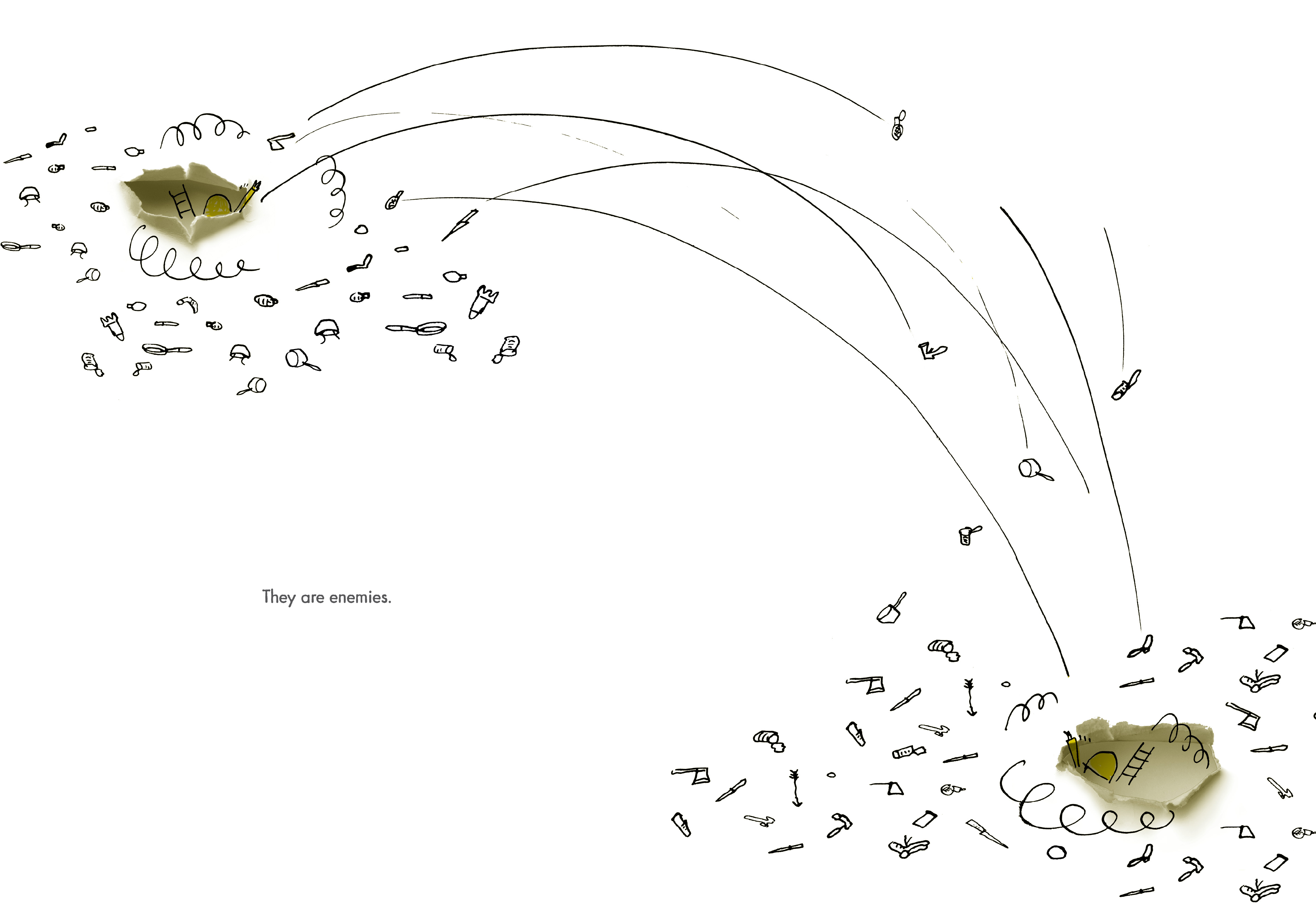
This unique book begins with a soldier in his lonely foxhole facing off against a mysterious opponent. His military-issue manual describes the enemy as dangerous and inhuman, and it is this ruthless and menacing description of the opponent that steels the soldier's resolve during combat. It is a simple matter of kill or be killed. As the war wages on, our soldier eventually sneaks into the other foxhole and discovers that his enemy may not be the monster that he was made out to be. The book ends with the two soldiers reaching out to each other, cautiously hopeful that they can end the fighting.
In April, Meghan Cox Gurdon of the Wall Street Journal had this interesting take on the book:
This book is very stylish, but it's pure propaganda: The idea is to perplex children about why war should ever happen and invite them to believe that nothing is worth fighting for -- when adults should know better.While I'm all for healthy skepticism, I think that there is more depth here than Gurdon realizes. While the book does not hide its antiwar message, there is another message here that is a little more nuanced than War is Bad or (in Gurdon’s words) that “nothing is worth fighting for.”
In the beginning we, through the soldier's experience, think that the enemy is the other soldier, but by the end the real enemy is revealed… and he isn’t the man in the other foxhole. So the question is: if not the other soldier, who is The Enemy in this story?
This is where the underlying message of Cali's book shines through. It's clear that these two soldiers were merely being manipulated from above and that "The Enemy" in this case is the faceless figure of authority that knowingly promulgated false information in order to justify and fan the flames of war.
History is riddled with examples of governments/movements manipulating information to justify war, and the decision to go to war is too serious for us to take information at face value. Cause if you don’t dig deeper, you may end up digging your own foxhole (or worse). It's not that "nothing is worth fighting for... but in order to know that something is worth fighting for, you have to know the truth.
Bloch’s illustrations do an amazing job of reinforcing this idea that information plays a large role in war. The illustrations take on the style of political cartoons, mimicking a popular vehicle for propaganda. But more interestingly is the way Bloch uses the page itself within the illustrations.
For example, the foxholes appear as torn holes in the page. (You should CLICK HERE to see images from the book, courtesy of the lovely ladies of 7 Impossible Things Before Breakfast). The page itself is the battlefield. This interplay between the page and the image further illustrates (pun sheepishly intended) that wars are fought not just on the front lines, but on the page: through newspaper editorials, policy briefs, political cartoons… wars are waged by words as well as by bullets and bombs.
So while I, like Gurdon, sometimes raise a skeptical eyebrow at overly simplistic anti-war literature, I don’t think that this is the case in The Enemy. Rather than perplexing children about "why war should ever happen", Cali's book tries to make them realize that if war should ever happen, you better make damn sure that you aren’t being duped into it.
I thought I was going to end it there, but a little digging on the internet revealed another interesting angle.
The Enemy was originally published in association with Amnesty International Australia in 2007. The original version features a highly decorated and smiling general (with sunglasses) below large print that says "Enemy".

Before we discuss the illustration, note that this version does not have the subtitle: A Book About Peace. This is interesting because in her WSJ review, one of Gurdon's points is that,
"The Enemy: A Book About Peace," by Davide Cali, does not so much promote peace as repudiate armed conflict.Which is a valid point and something that kind of bugged me too. But maybe it wasn't originally written as a book about peace at all. Maybe that subtitle was added on afterwards for marketing reasons. I wouldn't be surprised if US publishers were worried that a book about war would be too hard to promote, so they stuck the tagline "A Book About Peace" and switched out the diabolical general and slapped on a picture of an peacefully smiling soldier. Maybe that cover would be less likely to scare parents away.
Now let's look at the difference in the cover art. Interestingly, the smug general doesn't appear on the inside of the book at all. He remains above the fray (and outside the lines) making the decisions to send people to war. He only appears on the cover, which looks almost like a "Wanted" poster, a bold advertisement saying "This is the real enemy."
In fact, take a closer look at the illustration... it's hard to tell with this low resolution, but you can see that the general literally has blood on his hands.
So Gurdon was right about one thing: this is not a book about peace. This is a book about the horrors of war and the need to keep a close eye on those who have the power to declare it. Because it’s true: adults should know better. They should know better than to blindly accept jingoistic justifications for war without asking questions. After all, a knowledgeable public with the ability to question their leaders and hold them accountable is key to a healthy democracy. Anything that tells you otherwise is pure propaganda.
23 August 2009
The Five Chinese Brothers: The Movie

This controversial children's book classic is just begging to be adapted for the big screen... I can see it now:

Title: The Five Chinese Brothers
Tagline: If They Can’t Tell Us Apart, They Can’t Pick Us Out Of A Line-Up.
Plot: In this subversive action-adventure, five Asian-American friends, sick of people not being able to tell them apart, decide to use their anonymity to their advantage and plan the crime spree of a lifetime.
Director: Wai-keung LauProducer: Quentin Tarantino
Screenplay: Claire Huchet Bishop
Art Direction: Kurt Wiese
Note: In case you didn't recognize the poster, here is the original.
19 August 2009
The Curious Garden

Author/Illustrator: Peter Brown
On the surface, this quietly beautiful book is about a boy who discovers and cultivates a garden in the middle of the city. Through persistence (think The Carrot Seed on Miracle-Gro), the garden thrives and takes on a life of it’s own, slowly spreading throughout the city. More importantly, the garden inspires more gardeners, and soon the formerly drab city is blooming.
There is more than meets the eye here. If you scratch beneath the charming tale of environmental stewardship, you'll find an interesting meditation on the nature of ideas in the internet age.
In Brown's book, more important than the spreading of the garden is the spreading of the idea of gardening. Ideas are curious things indeed, and it is true that with a little persistence and cultivation, an idea has the ability to take on a life of its own. In the blink of an eye (or with the click of a mouse) an idea can spread and take root in even the tiniest crack (or niche market). If enough people pick up on the idea and are inspired by it, they will carry it themselves. Like twittering birds that spread vegetation by carrying seeds to distant lands, an idea can be spread by individuals as they fly across the internet.
Indeed, it is when other people in Brown's city get bit by the gardening bug, that the city really begins to explode. One garden by itself has limitations, but a sprawling network of people dedicated to gardening, now that is when broad social change really blossoms.
Whereas the normal term for this hyperkinetic spread of information is the vicious term to "go viral", the Curious Garden presents the phenomenon of this growth model with innocent beauty and childlike wonder. A message in The Curious Garden is that it takes a combination of sustained curiosity and innovative persistence to allow our ideas to bloom (that and a little bit of luck). The flipside of which is that the fertile garden of the imagination can easily dry up into a bleak and desolate landscape without proper care.
So, upon finishing the Curious Garden, I was left with three questions.
The first question is: What is your idea?
The second question is: Whether it is gardening, an innovative plan for universal health care, or customized bobblehead dolls, do you have the curiosity and persistence to cultivate your idea and allow it to grow?
The last question is: Do you believe in your idea enough to see it spread and possibly take on a life of its own?
Note: For a full review and a compendium of other on-line reviews, go check out (as always) A Fuse #8 Production.
18 August 2009
Penguin Great Ideas

and I couldn't resist whipping up a Bottom Shelf Books addition to the Penguin Great Ideas Series:

11 August 2009
At the Movies
Unfortunately, I don't have anything that can put your mind at ease about this:
10 August 2009
If You Give A Mouse A Dollar... He'll Rob an ATM?!

LA GRANDE, Ore. (Aug. 8) - A mouse found inside an automatic teller machine — along with a nest it had built with chewed-up $20 bills — gave an Oregon gas station employee the surprise of her life.
The mouse, discovered Thursday, had thoroughly torn up two bills and damaged another 14 to line his nest. Employee Millie Taylor said she screamed and slammed the machine's door shut.
The bank replaced all the money that wasn't extensively damaged, and the ATM has continued to work just fine. The mouse also got a reprieve: He was evicted from his nest but set free outside the station.
Other workers at the Gem Stop Chevron in La Grande in eastern Oregon say they're mystified about how the mouse got inside the machine.
27 July 2009
Great Lines in Children's Literature: Sam, Bangs & Moonshine
Sam, Bangs & Moonshine (Evaline Ness)
Now that is a great sentence. That is children's literature.
I was going to leave it at that, but then when I googled "Evaline Ness", I found out that she was married to Eliot Ness, the man who brought down Al Capone. WHAT?! Why this was never mentioned in The Untouchables?! It would have added an interesting dimension to the movie: Evaline trying to write/illustrate her children's books while dodging bullets from Capone's thugs. She could have even asked Sean Connery to proofread a draft for her. How much would you pay to hear Connery read the following passage?
"Moonshine was a mermaid-mother, a fierce lion, a chariot drawn by dragons, and certainly a baby kangaroo. It was all flummadiddle just as Bangs had told her."
Seriously, it would be worth the price of admission just to hear Connery say "flummadiddle". That would have wrapped up the Oscar for him right there.
I was always curious about Ness's choice of the word "moonshine" for the book... now, knowing her prominent role in the prohibition era, I only have more (and much more interesting) questions. Her husband was famous for his quest to enforce prohibition... yet in the book, Evaline has the line:
"There's good MOONSHINE and bad MOONSHINE," he said. "The important thing is to know the difference."
Was Evaline revealing her own moral misgivings surrounding her husband's role in the prohibition era?
Did her famous law enforcement husband share these same doubts with her behind closed doors?
Did the Ness's partake in a little moonshine themselves? Perhaps at a speakeasy called the Mermaid Mother?
Or was the book (which was printed in 1966, 20 years after her divorce from Eliot Ness) meant to be a not-so-subtle jab at her famous ex-husband?
These questions must be answered! I think it's high time the historians stepped to the plate and did some serious digging...
07 July 2009
Kristof's Best Kids' Books EVER!!!

A few good friends forwarded this column from the Sunday New York Times to me today: Nicholas Kristof, the renowned op-ed columnist for the NYT recently wrote about his favorite kids' books. It was an interesting list, but what is even more interesting is that if you look at his body of work, you can see that these childhood favorites really did have an impact on his writing career. Below are some examples:
Kristof Favorite: “Charlotte’s Web.” The story of the spider who saves her friend, the pig, is the kindest representation of an arthropod in literary history.
Related Kristof Article: "Humanity Even for Nonhumans." Writings by a Princeton scholar have popularized a movement to grant basic protections to pigs and chickens and to limit human dominion over other species.
Connection: To what extent do humans have the right to decide the fate of animals?
Kristof Favorite: “Wind in the Willows.” My mother read this 101-year-old English classic to me, and I’m still in love with the characters. Most memorable of all is Toad — rich, vain, childish and prone to wrecking cars.
Related Kristof Article: "It’s Time to Learn From Frogs." Scientists are beginning to find a connection between bizarre deformities in water animals and abnormalities in humans.
Connection: A young Kristoff learned valuable lessons in morality from a misbehaving anthropomorphized toad; scientists learn valuable lessons about humanity by studying genetically misbehaving amphibians.
Kristof Favorite: “Gentle Ben.” The coming-of-age story of a sickly, introspective Alaskan boy who makes friends with an Alaskan brown bear, to the horror of his tough, domineering father.
Related Kristof Article: "Obama, Misha and the Bear." President-elect Barack Obama needs a new approach to Russia if we want to avoid a new cold war, and we also need to get over our crush on Georgia’s president, Mikheil Saakashvili.
Connection: Coming-of-age story, of an skinny, introspective young president who attempts diplomatic relations with possibly hostile parties, to the horror of his tough, domineering predecessors.
I could go on, but I think you get the idea. The conversation continues, as Kristof invites people to list their favorites here.