31 August 2009

Horton Hears A Who (as 70's Thriller)


How psyched would you be if you pulled this slim paperback off the musty shelf of a used bookstore?

From the back cover:
This taut psychological thriller from bestselling author Theodor Geisel is the second installment of his acclaimed Horton series. As the book opens, we once again find Detective Horton waking from a weeklong bender. The sun is piercing, his head is pounding in his ears, and even the dust sounds like it's talking to him. As the day goes on, Horton realizes that he can't shake the voices in his head. Horton can't tell if he is psychic or psychotic, but he follows the voices and embarks upon a mind-bending journey. His feverish dedication leads him to social ridicule, lands him in jail, and threatens to leave his sanity in tatters.

"In the bizarre tradition that includes both Dashiell Hammett and Philip K. Dick, Giesel breaks new ground." -The New Yorker

"Destined to become a cult classic." -The San Francisco Chronicle

"Beware the Sour Kangaroo." -Rolling Stone

30 August 2009

BSB Flashback: Hop on Pop


9 April 2007

Author/Illustrator: Dr. Seuss

Many point to Bruno Bettelheim's award winning book, The Uses of Enchantment: The Meaning and Importance of Fairy Tales, as the moment that Freudian psychoanalysis officially came in contact with the realm of children's literature. While it is true that Bettleheim may have been one of the first academics to tackle the subject, it was the seminal work of Theodore Geisel (Dr. Seuss) that introduced children to Freud for the first time. Case in point: his playful exploration of the Oedipal complex: Hop on Pop.

Hop on Pop was published in 1963, a full 13 years before Bettelheim's Enchantment, and decades before Freud was widely dismissed by the psychological community as a coked-up sex fiend. Pop can be read as a thinly veiled introduction to the disturbing psychosexual theory that the father is the enemy who is preventing us from realizing some deeply ingrained sexual need for our mothers. Gross! Luckily, Seuss didn't get too caught up in the raging Sigmundsteria of the times, otherwise he may have been tempted to go all-out Oedipal and written his book as Hop on Pop then Marry Mommy, which probably would have tarnished his otherwise untouchable legacy.

Upon closer inspection, Freud and other psychological influences can be found sprinkled throughout Seuss's work. The Cat in the Hat is nothing more than a hyperkinetic romp through the subconscious with the Id, Ego, and Superego. The entire plot of Green Eggs and Ham is driven by Freud's theories of the repression and sublimation of base impulses. (What else could "Sam I Am" be, other than an anal-retentive individual's guilt-ridden projection of the repressed self and its latent desires?) And Horton Hears a Who? Horton hears a psychiatrist diagnosing him with schizophrenia, that's who he hears. In fact, if you read too closely, Seussville runs the risk of becoming an inescapable labyrinth of Freudian slips and slides... so maybe we're better off reading with eyes wide shut.

26 August 2009

War of Words


Author: Davide Cali
Illustrator: Serge Bloch

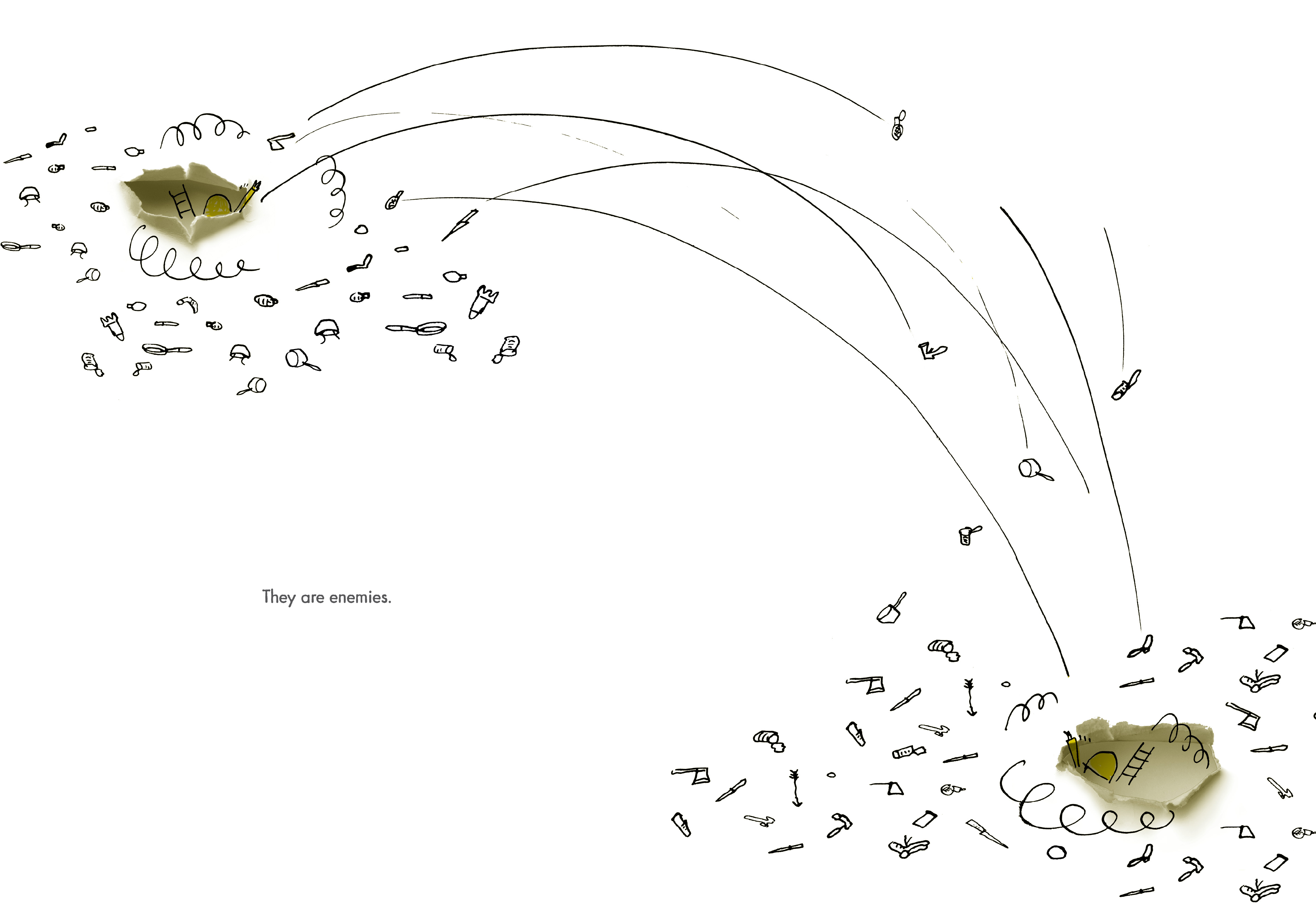
This unique book begins with a soldier in his lonely foxhole facing off against a mysterious opponent. His military-issue manual describes the enemy as dangerous and inhuman, and it is this ruthless and menacing description of the opponent that steels the soldier's resolve during combat. It is a simple matter of kill or be killed. As the war wages on, our soldier eventually sneaks into the other foxhole and discovers that his enemy may not be the monster that he was made out to be. The book ends with the two soldiers reaching out to each other, cautiously hopeful that they can end the fighting.

In April, Meghan Cox Gurdon of the Wall Street Journal had this interesting take on the book:
This book is very stylish, but it's pure propaganda: The idea is to perplex children about why war should ever happen and invite them to believe that nothing is worth fighting for -- when adults should know better.
While I'm all for healthy skepticism, I think that there is more depth here than Gurdon realizes. While the book does not hide its antiwar message, there is another message here that is a little more nuanced than War is Bad or (in Gurdon’s words) that “nothing is worth fighting for.”

In the beginning we, through the soldier's experience, think that the enemy is the other soldier, but by the end the real enemy is revealed… and he isn’t the man in the other foxhole. So the question is: if not the other soldier, who is The Enemy in this story?

This is where the underlying message of Cali's book shines through.
It's clear that these two soldiers were merely being manipulated from above and that "The Enemy" in this case is the faceless figure of authority that knowingly promulgated false information in order to justify and fan the flames of war.

History is riddled with examples of governments/movements manipulating information to justify war, and the decision to go to war is too serious for us to take information at face value. Cause if you don’t dig deeper, you may end up digging your own foxhole (or worse). It's not that "nothing is worth fighting for... but in order to know that something is worth fighting for, you have to know the truth.

Bloch’s illustrations do an amazing job of reinforcing this idea that information plays a large role in war. The illustrations take on the style of political cartoons, mimicking a popular vehicle for propaganda. But more interestingly is the way Bloch uses the page itself within the illustrations.

For example, the foxholes appear as torn holes in the page. (You should CLICK HERE to see images from the book, courtesy of the lovely ladies of 7 Impossible Things Before Breakfast). The page itself is the battlefield. This interplay between the page and the image further illustrates (pun sheepishly intended) that wars are fought not just on the front lines, but on the page: through newspaper editorials, policy briefs, political cartoons… wars are waged by words as well as by bullets and bombs.

So while I, like Gurdon, sometimes raise a skeptical eyebrow at overly simplistic anti-war literature, I don’t think that this is the case in The Enemy. Rather than perplexing children about "why war should ever happen", Cali's book tries to make them realize that if war should ever happen, you better make damn sure that you aren’t being duped into it.

I thought I was going to end it there, but a little digging on the internet revealed another interesting angle.

The Enemy was originally published in association with Amnesty International Australia in 2007. The original version features a highly decorated and smiling general (with sunglasses) below large print that says "Enemy".


Before we discuss the illustration, note that this version does not have the subtitle: A Book About Peace. This is interesting because in her WSJ review, one of Gurdon's points is that,
"The Enemy: A Book About Peace," by Davide Cali, does not so much promote peace as repudiate armed conflict.
Which is a valid point and something that kind of bugged me too. But maybe it wasn't originally written as a book about peace at all. Maybe that subtitle was added on afterwards for marketing reasons. I wouldn't be surprised if US publishers were worried that a book about war would be too hard to promote, so they stuck the tagline "A Book About Peace" and switched out the diabolical general and slapped on a picture of an peacefully smiling soldier. Maybe that cover would be less likely to scare parents away.

Now let's look at the difference in the cover art. Interestingly, the smug general doesn't appear on the inside of the book at all. He remains above the fray (and outside the lines) making the decisions to send people to war. He only appears on the cover, which looks almost like a "Wanted" poster, a bold advertisement saying "This is the real enemy."

In fact, take a closer look at the illustration... it's hard to tell with this low resolution, but you can see that the general literally has blood on his hands.

So Gurdon was right about one thing: this is not a book about peace. This is a book about the horrors of war and the need to keep a close eye on those who have the power to declare it.
Because it’s true: adults should know better. They should know better than to blindly accept jingoistic justifications for war without asking questions. After all, a knowledgeable public with the ability to question their leaders and hold them accountable is key to a healthy democracy. Anything that tells you otherwise is pure propaganda.

23 August 2009

The Five Chinese Brothers: The Movie


This controversial children's book classic is just begging to be adapted for the big screen... I can see it now:


Title: The Five Chinese Brothers

Tagline: If They Can’t Tell Us Apart, They Can’t Pick Us Out Of A Line-Up.

Plot: In this subversive action-adventure, five Asian-American friends, sick of people not being able to tell them apart, decide to use their anonymity to their advantage and plan the crime spree of a lifetime.

Director: Wai-keung Lau
Producer: Quentin Tarantino
Screenplay: Claire Huchet Bishop
Art Direction: Kurt Wiese


Note: In case you didn't recognize the poster, here is the original.

19 August 2009

The Curious Garden


Author/Illustrator: Peter Brown

On the surface, this quietly beautiful book is about a boy who discovers and cultivates a garden in the middle of the city. Through persistence (think The Carrot Seed on Miracle-Gro), the garden thrives and takes on a life of it’s own, slowly spreading throughout the city. More importantly, the garden inspires more gardeners, and soon the formerly drab city is blooming.

There is more than meets the eye here. If you scratch beneath the charming tale of environmental stewardship, you'll find an interesting meditation on the nature of ideas in the internet age.

In Brown's book, more important than the spreading of the garden is the spreading of the idea of gardening. Ideas are curious things indeed, and it is true that with a little persistence and cultivation, an idea has the ability to take on a life of its own. In the blink of an eye (or with the click of a mouse) an idea can spread and take root in even the tiniest crack (or niche market). If enough people pick up on the idea and are inspired by it, they will carry it themselves. Like twittering birds that spread vegetation by carrying seeds to distant lands, an idea can be spread by individuals as they fly across the internet.

Indeed, it is when other people in Brown's city get bit by the gardening bug, that the city really begins to explode. One garden by itself has limitations, but a sprawling network of people dedicated to gardening, now that is when broad social change really blossoms.

Whereas the normal term for this hyperkinetic spread of information is the vicious term to "go viral", the Curious Garden presents the phenomenon of this growth model with innocent beauty and childlike wonder. A message in The Curious Garden is that it takes a combination of sustained curiosity and innovative persistence to allow our ideas to bloom (that and a little bit of luck). The flipside of which is that the fertile garden of the imagination can easily dry up into a bleak and desolate landscape without proper care.

So, upon finishing the Curious Garden, I was left with three questions.

The first question is: What is your idea?

The second question is: Whether it is gardening, an innovative plan for universal health care, or customized bobblehead dolls, do you have the curiosity and persistence to cultivate your idea and allow it to grow?

The last question is: Do you believe in your idea enough to see it spread and possibly take on a life of its own?


Note: For a full review and a compendium of other on-line reviews, go check out (as always) A Fuse #8 Production.

11 August 2009

At the Movies

If you are a bit skeptical about the Where The Wild Things Are movie, maybe Maurice Sendak himself can put your mind at ease:


Unfortunately, I don't have anything that can put your mind at ease about this:

10 August 2009

If You Give A Mouse A Dollar... He'll Rob an ATM?!


Looks like that greedy little mouse is at it again:

From AOL News:
LA GRANDE, Ore. (Aug. 8) - A mouse found inside an automatic teller machine — along with a nest it had built with chewed-up $20 bills — gave an Oregon gas station employee the surprise of her life.

The mouse, discovered Thursday, had thoroughly torn up two bills and damaged another 14 to line his nest. Employee Millie Taylor said she screamed and slammed the machine's door shut.

The bank replaced all the money that wasn't extensively damaged, and the ATM has continued to work just fine. The mouse also got a reprieve: He was evicted from his nest but set free outside the station.

Other workers at the Gem Stop Chevron in La Grande in eastern Oregon say they're mystified about how the mouse got inside the machine.

27 July 2009

Great Lines in Children's Literature: Sam, Bangs & Moonshine

“Sam said her mother was a mermaid, when everyone knew she was dead.”

Sam, Bangs & Moonshine (Evaline Ness)


Now that is a great sentence. That is children's literature.


I was going to leave it at that, but then when I googled "Evaline Ness", I found out that she was married to Eliot Ness, the man who brought down Al Capone. WHAT?! Why this was never mentioned in The Untouchables?! It would have added an interesting dimension to the movie: Evaline trying to write/illustrate her children's books while dodging bullets from Capone's thugs. She could have even asked Sean Connery to proofread a draft for her. How much would you pay to hear Connery read the following passage?

"Moonshine was a mermaid-mother, a fierce lion, a chariot drawn by dragons, and certainly a baby kangaroo. It was all flummadiddle just as Bangs had told her."


Seriously, it would be worth the price of admission just to hear Connery say "flummadiddle". That would have wrapped up the Oscar for him right there.

I was always curious about Ness's choice of the word "moonshine" for the book... now, knowing her prominent role in the prohibition era, I only have more (and much more interesting) questions. Her husband was famous for his quest to enforce prohibition... yet in the book, Evaline has the line:

"There's good MOONSHINE and bad MOONSHINE," he said. "The important thing is to know the difference."

Was Evaline revealing her own moral misgivings surrounding her husband's role in the prohibition era?

Did her famous law enforcement husband share these same doubts with her behind closed doors?

Did the Ness's partake in a little moonshine themselves? Perhaps at a speakeasy called the Mermaid Mother?

Or was the book (which was printed in 1966, 20 years after her divorce from Eliot Ness) meant to be a not-so-subtle jab at her famous ex-husband?

These questions must be answered! I think it's high time the historians stepped to the plate and did some serious digging...

07 July 2009

Kristof's Best Kids' Books EVER!!!


A few good friends forwarded this column from the Sunday New York Times to me today: Nicholas Kristof, the renowned op-ed columnist for the NYT recently wrote about his favorite kids' books. It was an interesting list, but what is even more interesting is that if you look at his body of work, you can see that these childhood favorites really did have an impact on his writing career. Below are some examples:

Kristof Favorite: “Charlotte’s Web.” The story of the spider who saves her friend, the pig, is the kindest representation of an arthropod in literary history.

Related Kristof Article: "Humanity Even for Nonhumans." Writings by a Princeton scholar have popularized a movement to grant basic protections to pigs and chickens and to limit human dominion over other species.

Connection: To what extent do humans have the right to decide the fate of animals?

Kristof Favorite: “Wind in the Willows.” My mother read this 101-year-old English classic to me, and I’m still in love with the characters. Most memorable of all is Toad — rich, vain, childish and prone to wrecking cars.

Related Kristof Article: "It’s Time to Learn From Frogs." Scientists are beginning to find a connection between bizarre deformities in water animals and abnormalities in humans.

Connection: A young Kristoff learned valuable lessons in morality from a misbehaving anthropomorphized toad; scientists learn valuable lessons about humanity by studying genetically misbehaving amphibians.

Kristof Favorite: “Gentle Ben.” The coming-of-age story of a sickly, introspective Alaskan boy who makes friends with an Alaskan brown bear, to the horror of his tough, domineering father.

Related Kristof Article: "Obama, Misha and the Bear." President-elect Barack Obama needs a new approach to Russia if we want to avoid a new cold war, and we also need to get over our crush on Georgia’s president, Mikheil Saakashvili.

Connection: Coming-of-age story, of an skinny, introspective young president who attempts diplomatic relations with possibly hostile parties, to the horror of his tough, domineering predecessors.

I could go on, but I think you get the idea. The conversation continues, as Kristof invites people to list their favorites here.

11 June 2009

A is for Angst


I saw this book by Joost Ellfers and was immediately reminded of Miranda July's 2008 bestselling book of short stories: No One Belong Here More Than You.


Upon further inspection, the two books are actually very similar, deftly mixing heavy doses insecurity and angst with hints of charm and quirk. I thought it was just a coincidence until I saw this picture of July:


The resemblance is uncanny. Could there be a secret Joost-July alliance that we're not aware of? If not, should we request one?

10 June 2009

"Not My Problem"

You may have seen this already, but the Onion A.V. Club has an interesting breakdown of the DVD commentary accompanying the garish trainwreck/nightmare that was the Cat In the Hat movie (which is nice, since no one in their right mind would by the DVD, let alone sit through the commentary).

The article highlights this revealing quote from the director Bo Welch:

"See, we addressed the book—at least the cover and the back cover. What happens in between there is not my problem."

06 June 2009

Terrible, Horrible, No Good, Very Bad Twitter

So, I decided to try giving this twitter thing a whirl... and after playing around with it, I thought... you know who Twitter would be a good format for? Alexander from Alexander and the Terrible, Horrible, No Good, Very Bad Day! (Judith Viorst and Ray Cruz). I can just imagine Alexander, moping around all day, typing in disgruntled updates on his iPhone...


AlexanderNoGood teacher just said i sing too loud. :(

AlexanderNoGood
@ school, Mrs. Dickens liked Paul's pic of boat better than my invisible castle.

AlexanderNoGood I can tell this is going to be a terrible, horrible, no good, very bad day.

AlexanderNoGood
In carpool: becky, audrey, + elliot got window seats. I was scrunched, smushed, and car sick.

AlexanderNoGood
i found cereal in my cereal. :( think i'll move to Australia.

AlexanderNoGood
@ breakfast: Anthony found Corvette Sting Ray kit in cereal. Nick found Jr. Undercover Agent code ring in cereal.

AlexanderNoGood
I can tell this is going to be a terrible, horrible, no good, very bad day.

You get the idea. If you want to check out his twitter page and see running proof that it was indeed a terrible, horrible, no good, very bad day. (and here's a link to mine, which will--hopefully--be less of a downer.)

19 May 2009

Cloudy No More!

A while ago, I posted about Cloudy With A Chance Of Meatballs, pointing out some of the delightfully bizarre illustrations, one of which was what appeared to be baby heads stuck to the front of a garbage truck.


Well, Ron Barrett left a comment setting the record straight:

"I illustrated this book. To clarify the heads: sanitation workers in New York City find dolls in the trash place the heads on the the rods at the front corners of their trucks which they use to navigate through tight spots. One can also see teddy bears on the radiator grills. What the reader sees is the work of playful garbagemen, not sadistic maniacs."

So, there you have it! Mystery solved! Thanks, Ron!

Note: In case Mr. Barrett is reading again, I didn't actually think that the garbagemen were sadistic maniacs--or that the town of Chewandswallow was a brutal totalitarian regime... :)

13 May 2009

Miss Nelson Is Missing: The Movie

Cause it's only a matter of time, right?


IMDB entry

User rating:
6.5/10

Director: Clint Eastwood
Writer: Henry Allard
Artistic Director: James Marshall

Genre: Mystery/Thriller

Tagline: "Their teacher is missing... and they have no one to blame but themselves."

Plot: When their teacher (Drew Barrymore) mysteriously disappears, the students (led by Dakota Fanning and Bobb'e J. Thompson) enlist the help of a hapless detective (Seth Rogan) to track her down.

05 May 2009

In the Night Kitchen

Maurice Sendak's classic In the Night Kitchen, re-released as a memoir:


From Publisher's Weekly: Bourdain's latest behind-the-scenes memoir is another no-holds-barred adventure into the surreal underbelly of the restaurant industry. And never one to shy away from controversy, the rebellious Bourdain writes with two objectives in mind: shock and awe. There is one particularly bizarre scene involving full frontal nudity and getting "baked" in the kitchen that is sure to cause a stir among those with a more sensitive palette... but the rest of us should settle in for the meal of a lifetime. With Bourdain and Sendak in the night kitchen, you're guaranteed to have your cake and eat it too.

04 May 2009

Little Mole In Action (Figure)

The Story of the Little Mole in Search of Whodunnit has inspired the creative bunch over at Live 'n Learn to make their very own Little Mole action figure... how cool is that? They should get in touch with Holzwarth and Erlbruch to produce a whole line of these babies... throw in some creative use of tootsie rolls and you've got hours of zany educational fun!

01 May 2009

One more for good luck

From the Unnecessary Sequels cutting room floor, here is another honorable mention for your viewing pleasure. I was playing around with this idea while the judges were deliberating, but didn't actually finish it... thought you all might get a kick out of it anyway. This one is also courtesy of the unstoppable Kate Coombs:
The Very Bulimic Caterpillar: Caterpillars aren't supposed to be fat because fatness is unattractive, also it's unhealthy. One little caterpillar learns an important lesson in this colorful picture book about what to do if you feel waaaay too full!

26 April 2009

That's All, Folks!

All good things must come to an end... and the Unnecessary Children's Book Sequels That Never Were is now over (and I hope you thought it was good while it lasted!). Farida has a nice two part round-up of the submissions (Part I and Part II) that didn't get illustrated, but were hilarious nonetheless. Truth is, I would have tried to illustrate them all if I had the time, and I may still work up another one here and there if I get a chance. But it was a lot of fun, thanks everyone and maybe we'll do this again soon!

Here is a quick round-up of the results:

First Place: Harry and the Can of Purple Spray Paint (Kate Coombs)


Second Place: The Very Hungry Larva (Elaine Magliaro)


Third Place: Kitty's First Meteor Hurtling On A Terrifying Death Path Toward Earth (Hannah Mahoney)


And some of the Honorable Mentions:


24 April 2009

Unnecessary Sequel First Place Winner: Harry and the Can of Purple Spray Paint

Finally, the moment you've all been waiting for... First place in Saints and Spinners' Unnecessary Children's Book Sequels That Never Were Contest goes to Kate Coombs with her unnecessary sequel to Crockett Johnson's masterpiece, Harold and the Purple Crayon:
Harry and the Can of Purple Spray Paint: Whatever you do, don't call him Harold. He's a big boy now, and he wields a mean can of spray paint! Follow Harry up and down dirty alleys and streets, also beneath overpasses, in this touching sequel. Remember: when you see that magical purple tag, an H with a skull-handled dagger slashing through it, you know Harry's been there and left his mark. -Kate Coombs


So there you have it! Congratulations, Kate!

And a big thanks to everyone who submitted their awesome suggestions... and thank you Melangell and Phil for judging and of course, thank you Farida for thinking up and organizing the contest!

23 April 2009

Unnecessary Sequels: More Honorable Mentions

The Unnecessary Children's Book Sequels That Never Were Contest had a whole bunch of fun submissions that played on Shel Silverstein's The Giving Tree, so it had to make it as an honorable mention:


The Taking Tree
: Shel Silverstein's sequel to The Giving Tree proves to be much less popular, as children everywhere shun trees for fear of grabby branches and thieving twigs, and parents complain about the bad morals being conveyed to their impressionable tots. Book rated highly with test audiences, but it was later revealed that test audience consisted mainly of rhododendrons. -a.fortis, Finding Wonderland

The Tree: Co-dependent No More!
: A burst of insight leads the formerly Giving Tree to shed its unhealthy relationship with The Boy as it sprouts a new branch from the stump it has become. -MotherReader

Counting Rings: A Very Special Crime Scene Investigation of 'The Giving Tree': Using the current DSM-V (Diagnostic and Statistical Manual of Mental Disorders), "Counting Rings: A Very Special Crime Scene Investigation of 'The Giving Tree'" breaks down, in a child-friendly counting-book way, the psychoses and delusions behind your child's first - and favorite - dysfunctional relationship. -Lee Wind
http://www.leewind.org

The Irate Stump: The Giving Tree has a few regrets . . . -Jamie Michalak

The Trading Tree: The story of a cunning tree which, starting with the offer of an apple for allowance, slowly trades a young boy out of his considerable inheritance over the course of his life, leaving him with nothing but a place to sit. -Tony Dowler (not an official entry, since he's a relation...)

And one more for good measure--the unnecessary sequel to Bread and Jam For Frances:

Brie and Foie Gras For Frances: After spending a month-long summer vacation in Paris with her parents and younger sister, Frances returns home and refuses to eat anything other than brie cheese and foie gras imported from France. -Elaine Magliaro


That's it for now. Remember to check in with Saints and Spinners on Friday to see who got first place in the contest!

p.s. there are a ton of other honorable mention worthy submissions that I hope to get too in time... unfortunately, if I spend any more time on photoshop my eyes might pop out of my skull and/or my wife might stuff my laptop down the garbage disposal (with good reason).

22 April 2009

Unnecessary Sequels Second Place Winner: The Very Hungry Larva (or Moth Madness)

Second Place in the Unnecessary Children's Book Sequels That Never Were Contest goes to Elaine Magliaro of Wild Rose Reader and her sequel to Eric Carle's The Very Hungry Caterpiller:
The Very Hungry Larva or Moth Madness: This is the tale of a "mad about plaid" caterpillar that eats his way through all the heirloom tartans in a Scottish castle. The larva is finally caught and "kilt" by a wild and woolly sheep shearer and his weaver wife who live on the banks of Loch Lamb. -Elaine Magliaro


Congratulations Elaine, and thanks for the great suggestion! 1st Place (and maybe a few more honorable mentions) will continue to rollout during the rest of the week. Check in with Saints and Spinners for all the details!

Note: Contest judges were the worldy and wise Melangell and Phil. Thanks guys!

21 April 2009

Unnecessary Sequel Honorable Mention: Wet Dog, Wet Dog, What Do You Smell?

Tomorrow, Saints and Spinners will announce the 2nd Place Winner in the Unnecessary Children's Book Sequels Contest. Until then, here is another Honorable Mention via a submission from Yat-Yee (and not just because she asked nicely... though she did):

An unnecessary addition to Eric Carle's iconic Brown Bear, Brown Bear, What Do You See? series: Wet Dog, Wet Dog, What Do You Smell?


...or if you want one of Penguin's newer/edgier designs, try the Penguin UK Modern Classics version:


That's it for now! (Hope that didn't gross you out too much!)
Remember to check in tomorrow at Saints and Spinners to find out who is the second place winner of the Unnecessary Children' Book Sequels That Never Were Contest!

20 April 2009

Unnecessary Sequel Third Place Winner: Kitty’s First Meteor Hurtling on a Terrifying Death Path Toward Earth

Third Place in the Unnecessary Children's Book Sequels That Never Were Contest goes to Hannah Mahoney with her sequel to Kevin Henkes' modern classic, Kitten's First Full Moon:
Kitty’s First Meteor Hurtling on a Terrifying Death Path Toward Earth: Henkes goes for the dark side in the sequel to Kitten’s First Full Moon. Please note that scenes of worldwide panic and of the apocalyptic destruction of the eastern seaboard may not be appropriate for the very youngest readers. -Hannah Mahoney (Copy Manager, Candlewick Press)


And then of course (as with all successful children's books these days), comes the blockbuster movie adaptation:


Congratulations Hannah, and thanks for your winning submission! 2nd and 1st Place (along with more honorable mentions) will be coming up throughout the week. Check in with Saints and Spinners for all the details!

Note: Contest judges were the eminent Melangell and Phil. Thanks guys!

19 April 2009

Unnecessary Sequel Honorable Mention: Where The Wild Things Aren't

The wise judges (Melangell and Phil) have spoken! Check in with Saints and Spinners tomorrow (Monday) as she unveils the results. She will announce the winners and I will post the illustrations here. In the meantime, there were a lot of great submissions for a sequel to Where The Wild Things Are, so I was compelled to make one:


Thanks to everyone for their creative suggestions, and stay tuned for more throughout the week!

Where the Wild Things Aren't: a loving commentary on boredom and conformity. -Greg W.

Where the Wild Things Aren't: After seeing his pediatrician and a child psychologist, max is prescribed medication for his anger management issues and night terrors. -Rocco Staino and Cynthia Sandler

Where the Wild Things Are Having a Bash: Max grows up and leaves home for Carousal State College--the biggest party school in the country. There, he meets other "wild things" and sails off with them into drunken oblivion every weekend. Of course, when he sobers up on Monday mornings, his Friday night dinners are always cold and moldy. -Elaine Magliaro

Where the Wild Things Aren't: Max grows up, becomes an accountant, marries the nice Jewish girl next door and spends the rest of his life in painful anonymity. -The Library Lady

Wild Things: A Tropical Theme Park: This picture book is a story about an important industry called tourism. In it, we welcome you to a tropical paradise reached by some pretty clever chronological sailing. See our monsters in their very specially designed habitat and later you can even watch a trained monster show while sipping on banana daiquiris as the sun sets over the ocean. Written and developed by Imperial Corporate, Inc. just for you. -Kate Coombs

16 April 2009

The Paper Bag Princess


Author: Robert Munsch
Illustrator: Michael Martchenko

The moral of The Paper Bag Princess is a welcome and subversive take on your standard fairy tale fare. A pretty princess loses her clothes and realizes in the end that she doesn't need all those pretty clothes to be a princess. She emerges stronger, more independent, and wielding a new vision of femininity that serves her well as she battles dragons, close-minded boyfriends, and the wedding industry.

Unfortunately, I think the message of this book may have been too subtle because the moral seems to have been lost on some of our modern day princesses. Whereas the original Paper Bag Princess shed her clothes in a bold act of defiance, bravely discarding the trappings and confines of traditional femininity, today's female royalty are shedding their clothes for an entirely different reason.

The phenomenon was thoroughly examined in Ariel Levy's Female Chauvinist Pigs: Women and the Rise of Raunch Culture, and will be further explored in Almeta Grayson's new book Paper Bag Princess, which profiles the disturbing trend of sexual exploitation as a route to fame. (exhibit A: Paris Hilton; exhibit B: Kim Kardashian).

From Publishers Weekly: "These sobering portraits force the reader to question a society that not only encourages this brand of sexploitation, but rewards it with prime time TV deals and endless magazine covers. A well-balanced but jarring social critique, Paper Bag Princess will change the way you watch TV... and how you see the world."


Note:
This started out as a standard satirical post, but I have to admit that I am legitimately disturbed by this. Maybe it's because I'm getting to the age where the idea of fatherhood is not just a distant and abstract concept, but I consistently find myself flipping through the TV saying to myself (or my wife), "Our children will not watch TV. We are moving to a remote cabin in the woods where E! cannot find us." Call me a prude, but the idea of raising a daughter in a world where sex tapes are a legitimate path to stardom scares the sh!t out of me.

A Lighter
Note: For a more thorough discussion of the actual Paper Bag Princess, see Fuse #8's profile of the book, which came in at #70 in her Top 100 Picture Books List.

15 April 2009

Unnecessary Children's Book Sequels Contest - Honorable Mention: I Am Still A Bunny

While the winners of the contest are still being determined, here is something to give you a taste of the Unnecessary Children's Book Sequels Contest results. This is a great entry that didn't quite make the final cut, but I couldn't resist making a cover for it. This one is a sequel to the classic I Am A Bunny and comes courtesy of Charlotte of Charlotte's Library:

"I Am Still a Bunny" by Ole Risom.

We've already spent one fun-filled year with Nicholas the Bunny. Now the cute rabbit takes another trip through the seasons, in which he continues to be a passive, isolated observer of the pagent of life. "In spring, I watch other animals making friends." Children will be comforted by the fact that flowers still bloom, leaves still fall, and Nicholas is still watching them.


In case the resolution is not clear enough for you to read the quote at the top, it says:

"A devastating meditation on the nature of passivity in a society obsessed with hyper-engagement. If only we could all still be bunnies."
-Jonathan Franzen, author of How To Be Alone

Thank you, Charlotte for that awesome suggestion! Stay tuned for more soon...

Note: Not all of the contest illustrations will be children's books re-imagined as books for grown-ups... but I reserve the right to scratch that book design review itch when necessary.

14 April 2009

Bottom Shelf Books Redesigned: Goodnight Moon

While prepping for the Unnecessary Picture Book Sequels Contest (the results of which we will begin revealing any day now), I remembered a feature that I'd been wanting to do for a while: Redesigning classic picture book titles as grown-up novels. I think it's because I've spent too much time stalking Book Design Review and other such sites that appeal to an amateur dork like me.

So here is the first installment... Goodnight Moon redesigned as a noir-ish novel: