13 August 2013

If Famous Authors Read One-Star Reviews of Their Books (@BookRiot)

This post originally appeared on Book Riot.


It seems like every couple months I see a post go around about Amazon one-star reviews of classic books. Recently there was Buzzfeed’s Depressing One Star Reviews of Classic Literature and earlier this year Book Riot’s own Johann Thorsson compiled some doozies in his post on One-Star Reviews of Beloved Books.
Keep ‘em coming, internet. They never disappoint.
Inspired by Jimmy Kimmel’s always funny Celebrities Read Mean Tweets, I thought it’d be fun to imagine these authors reading their own one-star reviews. Sticks and stones may break your bones, but a bad review can really sting, man.
10 Authors Read One Star Reviews James Baldwin
One Star Review of James Baldwin’s GO TELL IT ON THE MOUNTAIN

One Star Review of THE COMPLETE POEMS OF EMILY DICKINSON

10 Authors Read One Star Reviews Jonathan Franzen
One Star Review of Jonathan Franzen’s FREEDOM

One Star Review of Flannery O'Connor's WISE BLOOD
One Star Review of Flannery O’Connor’s WISE BLOOD

10 Authors Read One Star Reviews Toni Morrison
One Star Review of Toni Morrison’s BELOVED

10 Authors Read One Star Reviews Haruki Murakami
One Star Review of Haruki Murakami’s 1Q84

10 Authors Read One Star Reviews Joan Didion
One Star Review of Joan Didion’s THE YEAR OF MAGICAL THINKING

One Star Review of Ernest Hemingway's THE SUN ALSO RISES
One Star Review of Ernest Hemingway’s THE SUN ALSO RISES

10 Authors Read One Star Reviews Junot Diaz
One Star Review of Junot Diaz’s THE BRIEF WONDROUS LIFE OF OSCAR WAO

10 Authors Read One Star Reviews JD Salinger
One Star Review of J. D. Salinger’s THE CATCHER IN THE RYE
____________________________

04 August 2013

A is for Achebe: Who Makes Your Author Alphabet (@BookRiot)

This post originally appeared on Book Riot.

A is for Achebe
As a newish father, it sometimes feels like the only organizing principle of my world is the alphabet. From books to blocks to magnets to soup, the alphabet has imposed its will and everything around me now automatically categorizes itself, shuffling obediently into its proper place in this efficient 26 character system.
With the alphabet on the brain (seriously, C is for Cookie is playing in my head as I type this) I thought this would be a fun question to throw out to the book-loving community: Who makes it onto your Author Alphabet?
You can use whatever criteria you want. It could be based on first or last name (or with tricky letters like Q and X, just do whatever the heck you need to do). It can have authors you love or ones that you loathe. You can have read their entire works or have never read a single word. You can try to make your alphabet diverse and representative, or you can fill it exclusively with female authors from the Mississippi Delta.
You get the idea. Anything goes.
Now that we’ve established the ground rules (or lack thereof), I’d like to hear from you all: Who makes it onto your Author Alphabet?
Here’s mine:
A: Achebe, Chinua
B: Borges, Jorge Luis
C: Coetzee, J. M.
D: Díaz, Junot
E: Egan, Jennifer
F: Fitzgerald, F. Scott
G: Galeano, Eduardo
H: Hurston, Zora Neale
I: Ishiguro, Kazuo
J: James, E. L. Johnson, Crockett
K: Kincaid, Jamaica
L: Lahiri, Jhumpa
M: Mitchell, David
N: Nabokov, Vladimir
O: O’Connor, Flannery
P: Pamuk, Orhan
Q: Quentin Blake
R: Rowling, J. K.
S: Saunders, George
T: Twain, Mark
U: Updike, John
V: Vonnegut, Kurt
W: Wallace, David Foster
X: Xingjian, Gao
Y: Yoshikawa, Eiji
Z: Zadie Smith

(Warning: Some of the letters force you into really hard decisions whereas others really make you stretch just to come up with a name. The above list is definitely not set in stone and I reserve the right to change my mind often–that’s the beauty of the “anything goes” rule.)

24 July 2013

Runaway Bunny starring Liam Neeson (@BookRiot)

[This post originally appeared on Book Riot.]

Credit for this mashup goes to reader Kyle Behymer who left this comment on a previous post:
Whenever I read The Runaway Bunny to my kids I hear Liam Neeson’s voice in my head: “I don’t know why you’re running away. I don’t know what you want. If you are looking for junk food I can tell you I don’t have any. But what I do have are a very particular set of skills; skills I have acquired over a very long career as a Mama Bunny. Skills that make me a nightmare for runaway bunnies like you. If you come home now, that’ll be the end of it and I will give you a carrot. But if you don’t, I will look for you, I will find you, and I will hug you.”
Well done Kyle, well done indeed. Anyone who has seen Taken knows that there are no lengths to which Liam Neeson won’t go for his children. Kyle recognized that the intensity of that parental devotion–which admittedly can be a bit dark at times–is matched only by that of the legendarily persistent Mama Bunny. (Make sure to check outKyle’s blog for a more in-depth look at the Neeson/Mama Bunny comparison.)
With Kyle’s permission, we took his idea and ran with it (pun unfortunately intended). So, without any further ado, here is Runaway Bunny starring Liam Neeson (screenplay by Margaret Wise Brown).

Liam Neeson as Runaway Bunny Title

Liam Neeson as Runaway Bunny 2

Liam Neeson as Runaway Bunny 3

Liam Neeson as Runaway Bunny 4

Liam Neeson as Runaway Bunny 5

Liam Neeson as Runaway Bunny 6

Liam Neeson as Runaway Bunny 7

Liam Neeson as Runaway Bunny 8

Liam Neeson as Runaway Bunny 9

Liam Neeson as Runaway Bunny 10

Liam Neeson as Runaway Bunny 11

Liam Neeson as Runaway Bunny 12

Liam Neeson as Runaway Bunny 13

Liam Neeson as Runaway Bunny 15

Liam Neeson as Runaway Bunny 14

Liam Neeson as Runaway Bunny 16

Liam Neeson as Runaway Bunny 17

Liam Neeson as Runaway Bunny 18
Guest collaborator Kyle is a human factors psychologist by day, and as the father of a two year old and an eight month old, a children’s book reading machine at night.  He has been chronicling the crazy thoughts that pop into his head while reading Goodnight Moon for the 5507th time at writingboutreading.blogspot.com.  When not reading, he enjoys traveling the world with his wife on a quest to find the best bite of food and offsetting this hobby by training for both adventure and endurance races.

23 July 2013

20 Books You Pretend to Have Read

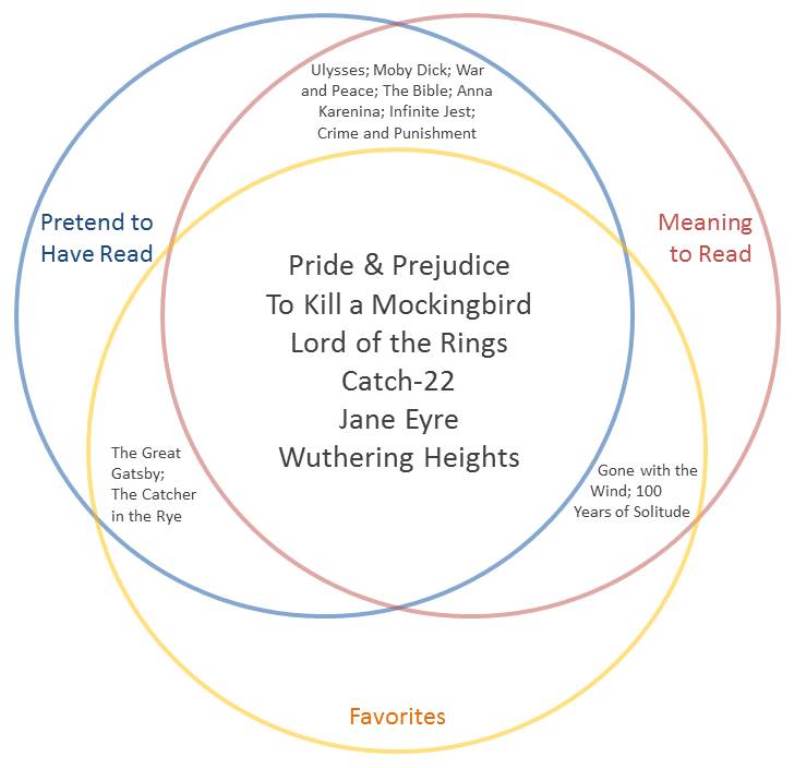
Book Riot recently ran another reader poll about what books people pretend to have read and asked me to help with some of the accompanying graphics, knowing that I can't resist the chance to make a venn diagram.

Click here for the full post.


BR Venn - 3 Polls final


Some links:

18 July 2013

Love You Forever: 5 of Hollywood's Sexiest Men Read to You from Children's Classics (@BookRiot)

This post originally appeared on Book Riot.

You know what they say: There is nothing sexier than a man reading a children’s book.
Okay, so I don’t know if anyone actually says that.
But as a man who is often spotted reading children’s books in public, I really want this to be a thing. Completely self-serving, I know. To help make this happen, I’ve recruited some of Hollywood’s most dashing leading men to read to you from beloved children’s classics.
Everyone together now: THERE IS NOTHING SEXIER THAN A MAN READING A CHILDREN’S BOOK.

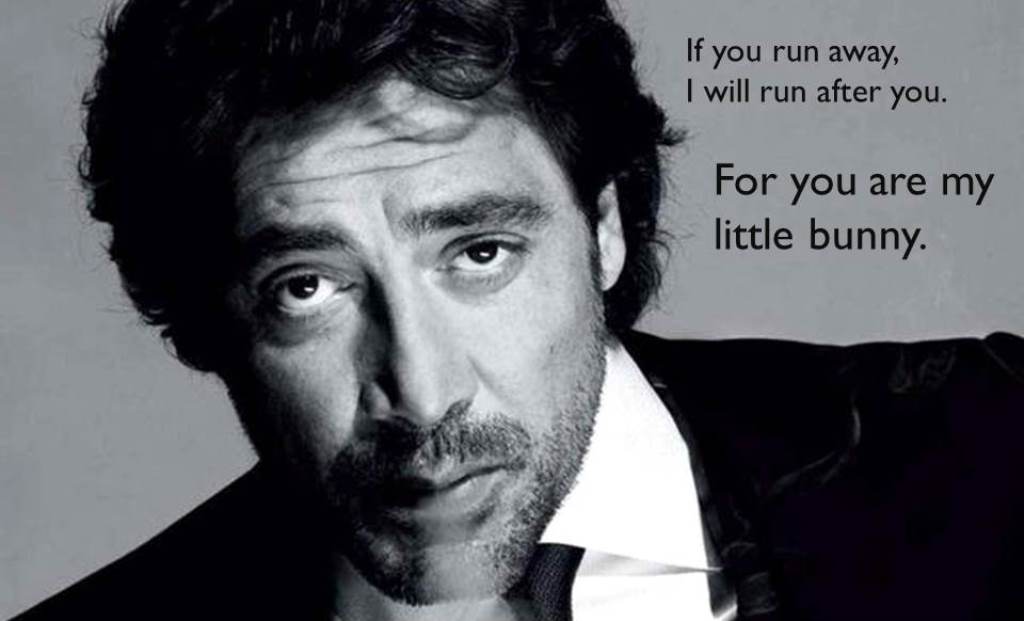
Javier Bardem reading from RUNAWAY BUNNY

Idris Elba reading from LOVE YOU FOREVER

Benedict Cumberbatch reading from MY LOVE WILL FIND YOU WHEREVER YOU ARE

Ryan Gosling reading from WINNIE THE POOH

Channing Tatum reading from CHICKA CHICKA BOOM BOOM

10 July 2013

Pride and Prejudice meets Parks and Recreation (@BookRiot)

CLICK HERE for the full post at Book Riot.

It is a truth universally acknowledged that a singular novel in possession of a devoted following must be in want of a mashup.
Pride and Recreation or Parks and Prejudice, whatever you want to call it, please join us on a tour of Jane Austen’s world–infused with the irrepressible spirit of Pawnee, Indiana.
Pride and Prejudice Parks and Recreation 1
Pride and Prejudice Parks and Recreation 2
starring Elizabeth Bennet
Pride and Prejudice Parks and Recreation 3
and Fitzwilliam “Mr.” Darcy
Pride and Prejudice Parks and Recreation 21
pride and prejudice parks and recreation mashup 27

02 July 2013

Favorite Book of the Year So Far: The Frank Show

Book Riot asked us to pick our favorite books of the year so far.  My choice was The Frank Show.  CLICK HERE to check out the full list.


The Frank Show by David Mackintosh 

My favorite picture book so far this year is about a young boy who worries about having to bring his curmudgeon of a grandfather into class for show-and-tell. While there is nothing surprising about the plot itself, the execution is so good that it doesn’t matter. Mackintosh’s illustrations are hilarious and intricately haphazard, if that makes any sense–think of a collaboration between Wes Anderson and Ralph Steadman.

And while the overall message is endearing, it never tips over into the sickeningly sweet. In the hands of another author you might get hit over the head with an overly sentimental life lesson that culminates with a group hug and a Cat Stevens song. Mackintosh, on the other hand, deftly handles the boy’s newfound appreciation for his grandfather who, despite his worn pajamas and creaky limbs, turns out to be quite the badass.


27 June 2013

Coloring Outside the Lines: The Diversity Gap in Children’s Literature(@BookRiot)


There's been a lot of interesting discussion in the kid's lit world about diversity thanks to Lee & Low's post on “Why Hasn’t the Number of Multicultural Books Increased In Eighteen Years?”. In particular, I was interested in the question raised by the always on point Betsy Bird, who said “we need to officially address how we feel about white authors and illustrators writing books about people of other races. Is it never okay? Sometimes okay? Always okay?”.

I took a stab at responding over at Book Riot. CLICK HERE to read it.


Some links:

The Good, the Bad, and the Unread

Book Riot recently polled its readers on their Favorite Novels, their Most Hated Novels, and theNovels They Keep Meaning to Read. The posts generated some lively debate, so we decided to take a closer look at the results.
Here is how the three lists overlap:
Note: the Favorites circle is larger because of a larger sample size.
Note: The Favorites circle is bigger because of a larger sample size.
CLICK HERE for the full article (and more venn diagrams!) at Book Riot

14 June 2013

The Narrative Magic of Picture Books: An Interview with Mac Barnett (@BookRiot)

If you don’t think picture books can be considered literary fiction, that Harold and the Purple Crayon is strictly child’s play, then a few minutes with Mac Barnett may change your mind. The author (whose works include Chloe and the Lion and Extra Yarn) speaks passionately about his craft and has strong opinions about the power and potential of children’s literature. After hearing him at a recent picture book panel in DC (where he held court on everything from metafiction to skeomorphism), I decided to track him down for a few questions.

[Click here for the full interview at Book Riot]

Also, definitely head over to Seven Impossible Things Before Breakfast to check out the joint interview with Mac, Jon Scieszka, and Matthew Myers about Battle Bunny.

07 June 2013

Zooey Deschanel as Amelia Bedelia: A Match Made in Quirk Heaven(@BookRiot)

Note: I originally posted this on Book Riot.
This year marks the 50th anniversary of one of the most beloved characters in children’s literature, Peggy Parish’s Amelia Bedelia. As luck would have it, the universe has provided us with the perfect actress to play her: Zooey Deschanel.
Deschanel oozes the odd-but-endearing nature that is Amelia Bedelia’s signature. For those of you who aren’t familiar with the classic series, Amelia Bedelia is a maid who is constantly getting into trouble for misunderstanding (or taking too literally) common sayings like, “drawing the drapes” or “stealing home plate.” Of course, Hollywood would probably modernize the script, replacing the iconic maid’s outfit with a closet of hipster-chic sun dresses and turning the story into some kind of millenial rom-com… maybe something like:
“Loveable but unlucky in love, Amelia Bedelia is a Brooklyn barista who gets fired after a series of unfortunate misunderstandings. Unwilling to move back in with her parents, she takes a job as a live-in maid for a wealthy Park Slope family. Despite her repeated mishaps, she slowly wins everyone over.  But the question remains: will she ever find true love?”
Here are a few scenes to whet your appetite for this hypothetical movie:
Things at her new place get off to a bit of a rocky start:
While things on the homefront improve, Amelia eventually becomes disillusioned with the single lifestyle:
Zooey Deschanel Amelia Bedelia 4
So she decides to start playing the field, with mixed results:
Zooey Deschanel as Amelia Bedelia - baseball
At one point she gets involved with and tries to help a guy with a shady past:
Then in an unexpected twist, the movie takes a bizarre science fiction turn:
But in the end, it looks like Amelia Bedelia might have found someone who actually gets her:
So, what do you say Hollywood? Coming soon to a theater near you?


Some links:

27 May 2013

Not all Bunnies and Birthday Cake: Experts on the State of Picture Books (@BookRiot)


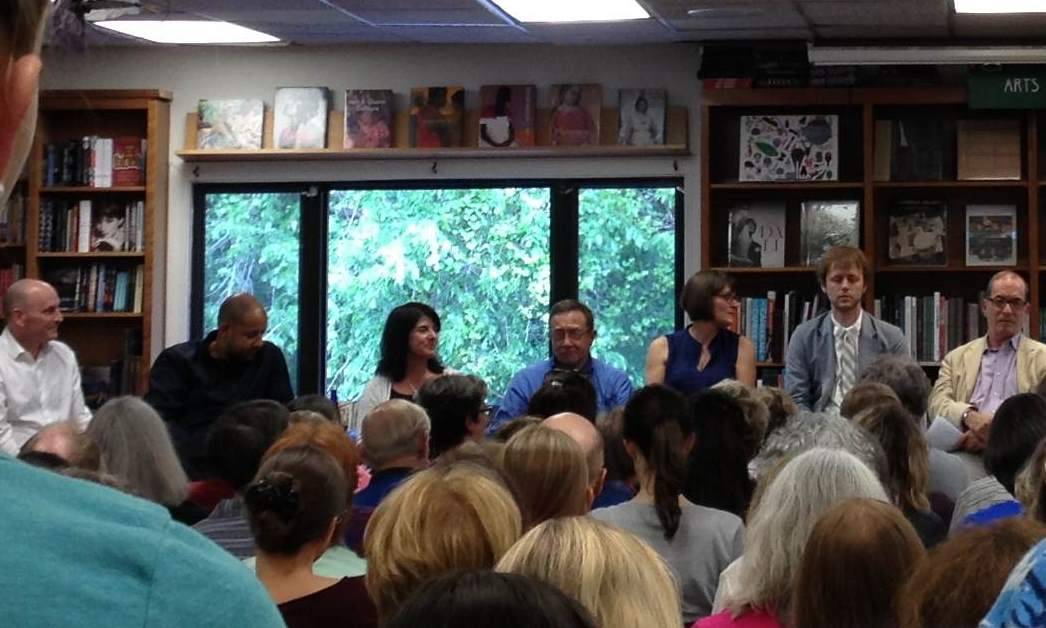
The national news may not have picked this up, but there was an important story out of DC last weekend. Gathering in our nation's capitol, a panel of experts declared that the picture book is in fact alive and well.
politics and prose picture book panel
The panel was held at Politics & Prose (DC’s preeminent independent bookseller) and featured some of the heaviest hitters in the industry: leading children’s literature scholar Leonard Marcus, editor Neal Porter, authors Jon Scieszka, Meg Medina, and Mac Barnett and author/illustrators Christopher Myers and Laura Vaccaro Seeger.
Now, if you expect a picture book panel to be all fluffy bunnies and birthday cake, then you would have been terribly disappointed. However, if you’re looking for an erudite discussion about the future of picture books with topics ranging from David Foster Wallace to nipples, then my dear friend you came to the right place.
Seated before a full house on a sunny Sunday afternoon, the panelists wasted no time taking a deep dive into the key issues of their field. For those who don’t have the good fortune of living near Politics & Prose, here are some highlights from the sprawling 90-minute conversation.
(Disclaimer: all quotes should be considered paraphrasing because while I did take notes, my handwriting makes chickenscratch look like Lucida Calligraphy.)
  • The Price We Pay: Does the high price point of picture books limit access for economically challenged populations? “We are pricing kids out of great stories,” Barnett lamented.  He and Scieszka pointed to literacy programs that betray their cause by distributing low-quality books (often cheap movie tie-ins) posing as literature. Scieszka, the first ever National Ambassador for Young People's Literature, made the simple but important point that "the way to get kids to be readers is to give them something great to read." And while many of the panelists agreed that the art of bookmaking is thriving, Myers wondered if there is a danger in commodifying books as artistic objects--if we’ve reached a point of no return where books are no longer viewed as essential, but as luxury items. Marcus then provided a counterpoint by bringing out the nerd hammer and declaring the picture book to be actually quite affordable once you’ve “ammortized the cost over a year of reading”.
  • Reflections on Race: Medina spoke forcefully about the challenges of writing geared towards a Latino audience, pointing out that “[America] is the only place where we’re Latinos, everywhere else we’re Guatemalans, Mexicans… there’s incredible diversity here and yet we’re all lumped into this one category.” Elaborating on the importance of diverse characters in literature, she described a potentially vicious cycle, because “children like to see themselves reflected in their books and if we want these children to become authors, we first have to fuel the fires that keep them interested in reading.”
  • Uptight Americans: Speaking on the global publishing industry, Porter was asked if the international community viewed Americans as uptight. While wary of playing up cultural stereotypes, he said, “My short answer is yes. Everywhere I go people say, ‘Oh you Americans, you are so afraid of the nipple.’”
  • Metafiction is Hilarious: Vaccaro Seeger (who’s brilliant First the Egg is an all-time great) pointed out that its “important to give children enough credit to challenge them—whether that’s using vocabulary that is not considered grade-level appropriate or challenging them conceptually and visually.” Barnett (who studied with David Foster Wallace) was especially excited about picture books as a perfect vehicle for experimental fiction (which is a particular soft spot of mine). Using the misadventures of Wile E. Coyote as an example, he said that while children might not get all the complexities of the joke, they laugh because, well, metafiction is hilarious. However, he also emphasized that the story still has to appeal to the young reader on a basic level because, “the stakes are high—if we don’t deliver [on other aspects of narrative], then they’ve been burned by experimental fiction.”
  • Eeeeeee! Books!: On the topic of ebooks, Barnett had a very even-handed perspective. This is where he brought the thunder by mentioning “skeomorphism” (in short, design intended to make one medium look like another material or technology.  Think faux-leather, or in this case, the animated page turn.) “Books for the iPad should be written for that format.  There can be amazing stories for ebooks… but they’ll be something different, they won’t be picture books.” Porter was more blunt, comparing the experience of the animated page turn to “pushing a dead fish”.
  • Whimsy vs. Dark Matter: Myers was most passionate when describing his desire to go to the dark side in his subject matter. “Children are dark little beings,” he declared to the delight of the crowd, “we have to give them a place to channel it.” And while describing the challenges of finding the right balance between the whimsical and the serious, he warned about the dangers of dichotomizing the two.  “We are giving kids ways to talk about their life, a vocabulary. If our stories only give them one or the other [the whimsical or the serious], then we have failed them.”
It was only a matter of time though before the conversation took its inevitable turn to fluffy bunnies and birthday cake—but not how you might expect. Scieszka and Barnett are collaborating on a new book. The concept is that a child receives a book called The Birthday Bunny, the most trite, cloying book imaginable (which Scieszka and Barnett wrote by “turning off their brains”).
The kid then takes it upon himself to alter the text and pictures, transforming it into the book he actually wants to read: The Battle Bunny.
This is a fun concept that kids can relate to that just happens to feature a complex layering of visual and written language and challenges children to consider (consciously or otherwise) the intricacies and possibilities of narrative. This is both kid’s play and not--and exactly what makes me love the world of picture books.
The field is filled with these incredibly innovative and passionate thinkers who are very serious about their craft, but do not take themselves too seriously. As the panel ended and the crowd dispersed, one thing was abundantly clear: while we may not be able to predict the future of the picture book, we do know that it is in very good hands.

05 May 2013

Best Books We Read in April (@BookRiot)

Great list here from all the BookRiot contributors.  My choice for the month was:


Giovanni’s Room by James Baldwin
There’s a great passage early on in Giovanni’s Room that’s incidental to the plot, but provides key insight into the main character, David.  He’s describing a car crash in which he was the drunk driver, but he tells his story completely in the passive voice:  “something weird happened to all my reactions”, “the car sprang suddenly out of my control”, and finally “a telephone pole, foam white, came crying at me out of the pitch darkness”.  Through this narrative alchemy, David manages to separate himself from the responsibility for his actions.  He didn’t so much cause the accident as the accident happened to him. As the story unfolds, you see David repeatedly rely on this self-preservation tactic.  He may feign self-loathing as he wreaks havoc on the lives of those around him, but whether he is steering friends into a tree or driving his lover toward tragedy, in his mind David is never truly at fault—he is merely the victim of circumstance.